English
 Portuguese
 Russian

This two-part article explores the technological advancements, real-world applications, and future trends behind fanless box PCs in edge computing. From their seamless integration with IoT ecosystems to their scalability and reliability, we’ll uncover how these devices are reshaping industries—one compact, high-performance unit at a time.
The Rise of Fanless Box PCs – Why Efficiency Meets Innovation
1. The Evolution of Edge Computing: Why Fanless PCs Are the Next Frontier
Edge computing has long been hailed as the future of data processing, but traditional PCs—especially those with bulky cooling systems—have posed significant challenges. High power consumption, heat dissipation, and maintenance costs have limited their adoption in industrial and IoT environments.
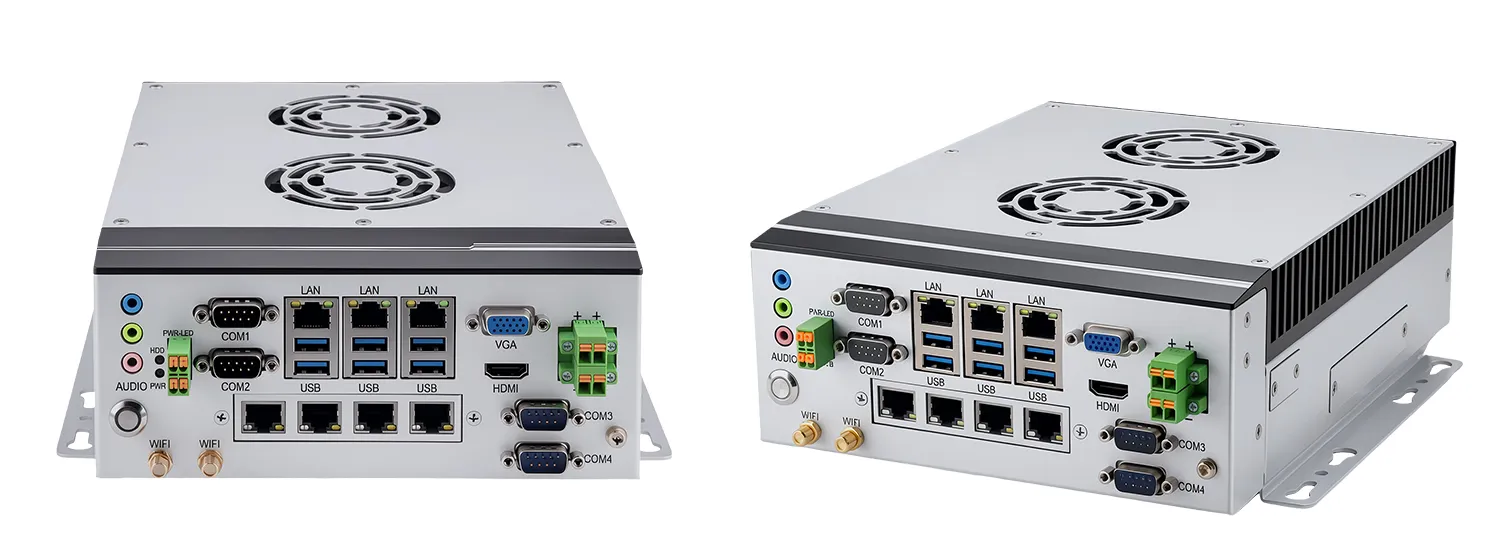
Enter fanless box PCs: a paradigm shift in computing design. Unlike conventional PCs, these devices eliminate the need for active cooling by leveraging passive heat dissipation technologies—such as heat sinks, thermal pads, and advanced thermal management materials. This not only reduces energy waste but also enhances reliability, making them perfect for 24/7 operations in harsh environments.
The shift toward edge computing has accelerated due to:
Bandwidth constraints – Moving data to the cloud introduces latency, which is unacceptable for real-time applications like autonomous vehicles or industrial robotics. Regulatory demands – Governments and industries are pushing for data sovereignty, meaning sensitive information must remain within local networks. Cost efficiency – Edge devices reduce reliance on cloud infrastructure, lowering bandwidth and latency costs.
Fanless box PCs align perfectly with these demands, offering high performance without the trade-offs of traditional cooling systems.
2. Key Technologies Powering Fanless Box PCs
The success of fanless box PCs hinges on several cutting-edge technologies:
A. Advanced Heat Dissipation Solutions
Most fanless PCs use passive cooling methods:
Thermal Conductive Pads – Materials like graphene or thermal interface materials (TIMs) improve heat transfer from the CPU to the heat sink. Heat Sinks with Integrated Fans (Optional) – Some models include low-noise, high-efficiency fans that only activate under extreme conditions. Phase-Change Materials (PCMs) – These absorb and release heat dynamically, maintaining optimal temperatures.
B. High-Performance Processors Optimized for Edge Workloads
Fanless PCs often feature low-power, high-efficiency processors designed for edge computing:
Intel Core Ultra (e.g., Alder Lake-U) – Offers up to 40% better performance per watt than previous generations. AMD Ryzen V2000 Series – Known for excellent thermal management and multi-core efficiency. Qualcomm Snapdragon X Elite – Ideal for mobile edge computing (MEC) applications like AR/VR and autonomous systems.
These processors support AI acceleration, real-time processing, and low-latency applications, making fanless PCs ideal for industrial automation, smart factories, and IoT gateways.
C. Compact Form Factors for Seamless Integration
Fanless box PCs come in various form factors, including:
Mini-ITX – Perfect for embedded systems in smart cameras, drones, and industrial robots. Single-Board Computers (SBCs) – Used in IoT edge nodes for lightweight applications. Rack-Mountable Units – Ideal for data centers and enterprise networks.
Their small size and modular design allow easy deployment in narrow spaces, reducing installation costs.
3. Real-World Applications Where Fanless Box PCs Excel
The versatility of fanless box PCs makes them indispensable across industries:
A. Industrial Automation & Smart Factories
In smart factories, real-time data processing is critical for predictive maintenance, quality control, and automation. Fanless PCs:
Process sensor data without latency. Run AI-driven analytics for predictive maintenance. Enable robotics with low-power, high-speed computing.
B. IoT & Smart City Deployments
From smart traffic lights to waste management systems, fanless PCs power:
Edge gateways for 5G and wireless networks. Weather stations and environmental monitoring. Smart parking systems with real-time analytics.
C. Autonomous Vehicles & Drones
In self-driving cars and drones, fanless PCs provide:
Low-latency processing for real-time decision-making. Energy efficiency for extended flight times. Reliability in extreme weather conditions.
D. Healthcare & Telemedicine
Fanless PCs enable remote patient monitoring by:
Processing medical imaging locally. Supporting AI diagnostics without cloud dependency. Ensuring secure data transmission in HIPAA-compliant environments.
4. The Future of Fanless Box PCs: Trends to Watch
As edge computing continues to evolve, fanless PCs will play an even bigger role:
AI & Machine Learning Integration – Future models will include dedicated AI accelerators for real-time inference. 5G & Edge Computing Synergy – Fanless PCs will become critical nodes in 5G networks, handling massive data flows. Sustainability & Green Computing – With lower energy consumption, these devices align with ESG (Environmental, Social, Governance) goals. AIoT (Artificial Intelligence + IoT) Expansion – Fanless PCs will drive smart cities, autonomous infrastructure, and next-gen robotics.
Performance Optimization & Cost-Effective Edge Computing with Fanless Box PCs